
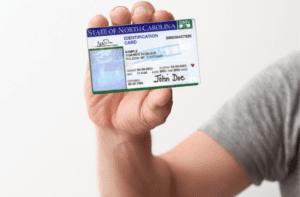
Valid Forms of Identification
Why, What, and How to Get One
It is essential to have at least a basic, valid form of identification or “ID” to accomplish almost any legal matter. However, we have noticed that seniors who are no longer driving often do not have any form of valid ID. This post discusses reasons you need a valid ID and how to obtain a basic ID in North Carolina.
What is a basic, valid ID?
A basic, valid ID must:
- Be issued by the federal or state government
- Have a photo of you
- Not be expired, and
- Have either your physical description or your signature.
An unexpired driver’s license meets this description, but an expired driver’s license does not, regardless of the fact that North Carolina will allow you to drive with an expired NC license (in NC) for two years (or until December 31, 2027, whichever comes first) if it expired on or after July 1, 2025.
Why should I have at least a basic, valid ID if I don’t drive?
Many important situations, other than being pulled over by the police, require you to produce a valid ID. For example: Opening a bank account, taking out a loan, obtaining certain types of medication from your pharmacy, and creating valid legal documents.
Why is a valid ID required to create or update my estate plan?
In North Carolina, your general power of attorney, health care power of attorney, and advance directive must be notarized to be valid, and you must present a valid ID to the notary, unless they know you personally. (Note, however, that a notary related to you often cannot notarize your signature on estate planning documents.)
Although your signature on your will is not required to be notarized, your will is not “self-proving” unless (among other important requirements) you have signed, sworn or affirmed to, and acknowledged it before a notary. You definitely want a self-proving will because there are several time-consuming and often costly steps to probating a will that is not self-proving, including locating the witnesses in order to “prove” the will. Sometimes it is simply not possible to probate a will if the witnesses have also died or have moved and cannot be located.
What counts as a valid form of ID if my driver’s license is expired?
See the requirements for a valid ID above. Here are four examples that meet those requirements if they are not expired:
- Identification card from the NC Department of Motor Vehicles (non-driving)(“State ID”)
- US Passport issued by the Department of State
- US Military ID if it contains either a signature or physical description (if it was issued after 2020, it will not contain a signature or physical description) (of note, a notary legally cannot make a copy of this due to federal law)
- Tribal ID from a state or federally recognized tribe
How do I Obtain a North Carolina State ID?
You can apply for a basic, valid ID (a “State ID”) through the North Carolina Department of Motor Vehicles (NCDMV). Their website has a lot of information, including how to obtain a “REAL ID” that will meet federal security standards. https://www.ncdot.gov/dmv/license-id/identification/Pages/default.aspx
General information about obtaining a State ID helpful for seniors who are no longer driving:
- Ideally, apply before your driver’s license expires. It’s easier.
Voluntary Surrender: If you no longer wish to drive, you can surrender your unexpired license at any NCDMV office and obtain a State ID.
Suspended or Revoked Licenses: As long as it is unexpired, surrender the license at any NCDMV office and obtain a State ID.
- If you license is expired, you will need to provide the following as proof of your identity:
- Proof of age and identity (e.g., birth certificate or U.S. passport)
- Social Security card or equivalent
- Proof of NC residency (e.g., utility bill, lease agreement)
- For non-U.S. citizens, provide proof of legal presence in the U.S.
- You are required to visit a NCDMV office unless you are truly homebound. If you are truly homebound, complete a Homebound Service Request Form found on NCDMV’s websiteand return the completed form via email, fax, or mail. You will also need to submit a letter from your physician confirming that you are homebound and need in-home services. If your application is approved, an NCDMV employee will come to your home to process the information necessary to obtain your new State ID. We know a few seniors who applied for homebound services and were denied.
At Rhodes Law Firm, PLLC, we work closely with our clients to best meet their needs. If they do not have a valid ID, we can provide guidance on how they might still be able to update or create their estate plan. If you have questions about your current estate plan, would like to update it, or do not currently have an estate plan, we would be happy to assist you. Contact our office through our website or call (919) 435-3646 and speak with our Client Services Specialist about your next steps.